FLOW in Supply Chain Risk
- bradluffy
- Feb 2
- 2 min read

Workbench Context
Most organizations say they “manage supply chain risk.”
What they usually mean is:
reacting to problems when they become visible, and
escalating issues based on urgency, not structure.
The problem isn’t awareness.
The problem is misclassification.
When every disruption is treated as equally serious — or equally minor — decision-making degrades fast.
FLOW exists to prevent that failure mode.
The Unit of Effort
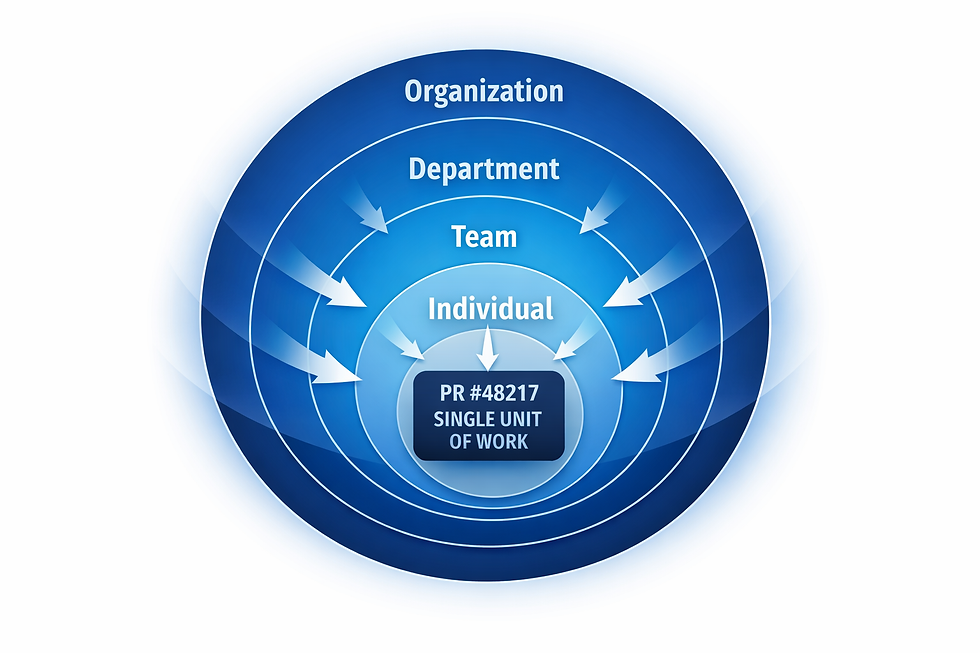
Single Unit of Effort: A specific supply disruption tied to a specific constrained input.
In this case:
“Supplier X cannot deliver Part Y as scheduled.”
Just one disruption — clean, bounded, and observable.
Everything that follows depends on this one unit's complexity and scale, rather than emotion, visibility, or noise.
Applying FLOW (One Unit, Many Flows)
FLOW A — Contained Disruption
Part Y supports one product line.
A substitute already exists
Inventory buffers absorb the delay
The impact is local and reversible
The disruption is real, but it does not spread.
FLOW A Takeaway:
This unit exhibits low complexity and low scale.
FLOW B — Expanded Scope
Part Y supports multiple product lines.
The disruption affects more than one planning stream
Coordination is required across teams
The cause and mitigation remain clear
The disruption spreads beyond a single local boundary.
FLOW B Takeaway:
This unit exhibits low complexity and moderate scale.
FLOW C — Complex Disruption
Part Y supports multiple product lines with conflicting constraints.
Tradeoffs are unclear or competing
Mitigation options introduce secondary risk
Outcomes depend on judgment and assumptions
The disruption is difficult to reason about cleanly.
FLOW C Takeaway:
This unit exhibits high complexity with limited or moderate scale.
FLOW D — System-Level Disruption
Part Y is critical across a large portion of the operation.
Downstream effects cascade across functions
Customer, revenue, or mission impact emerges
Coordination spans organizational layers
The disruption now affects the system as a whole.
FLOW D Takeaway:
This unit exhibits large scale, regardless of complexity.
FLOW S — Exceptional Disruption
Part Y triggers non-operational constraints.
Regulatory, safety, or security implications
Normal optimization logic no longer applies
Exception handling is required
The disruption exits standard operating bounds.
FLOW S Takeaway:
This unit represents a special case outside normal FLOW optimization.
What This Changes
Without FLOW:
Teams escalate early “just in case”
Leaders get pulled into routine scope issues
Truly systemic risks surface too late
With FLOW:
Most disruptions die quietly at FLOW A or B
FLOW C receives focused analytical attention
Leadership only engages when scale truly warrants it
Workbench Takeaway
Supply chain risk does not fail because disruptions happen.
It fails because organizations:
confuse scope with severity,
confuse repetition with scale,
and escalate emotionally instead of structurally.
FLOW fixes that by forcing one discipline:
"One unit of effort. Classified correctly. Re-evaluated as context changes."
That single habit turns supply chain risk from a source of constant anxiety
into something that can be managed as a routine operational activity.